Article: Why We Don’t Use a Diamond Search Tool - Less is More Series
Why We Don’t Use a Diamond Search Tool - Less is More Series
Why We Don’t Use a Diamond Search Tool
There are thousands upon thousands of diamonds available online at any given moment.
Which is exactly why we don’t think you need to see all of them.
If you’ve shopped for a diamond online, you probably know the format: enter a carat range, choose your color and clarity, select a shape, adjust a few sliders, and suddenly you’re looking at several hundred diamonds that appear, at least on paper, remarkably similar.
More choice sounds useful. In practice, it can make choosing a diamond much harder.
At Vellum Hall, we don’t use a traditional diamond search tool or plug-in inventory for our commissions and made-to-order jewelry. Instead, we source and select diamonds ourselves, narrow the field, and whenever possible, bring the stone in hand before presenting it to a client.
There are a few reasons for that.
More Diamonds Don’t Necessarily Make Choosing Easier
There’s a well-known concept in consumer psychology often referred to as the paradox of choice. One of the most famous examples is the “jam study,” in which shoppers were presented with either a large or small assortment of jams. The larger display attracted attention, but the smaller selection was more effective at getting people to actually choose.
Diamonds can create the same problem, only with considerably more money involved.
Give someone six nearly identical 1.5-carat diamonds and suddenly every tiny difference starts to feel enormously important. Is VS1 worth paying more for than VS2? Is G noticeably better than H? Why does one cost $700 more when the certificates look almost identical? Should you keep searching in case something better appears tomorrow?
At some point, access to more information stops creating clarity.
Our job isn’t to hand you the entire diamond market. It’s to know that market well enough to edit it.
We Like Diamonds That Don’t Behave Particularly Well on a Spreadsheet
This is probably the bigger reason.
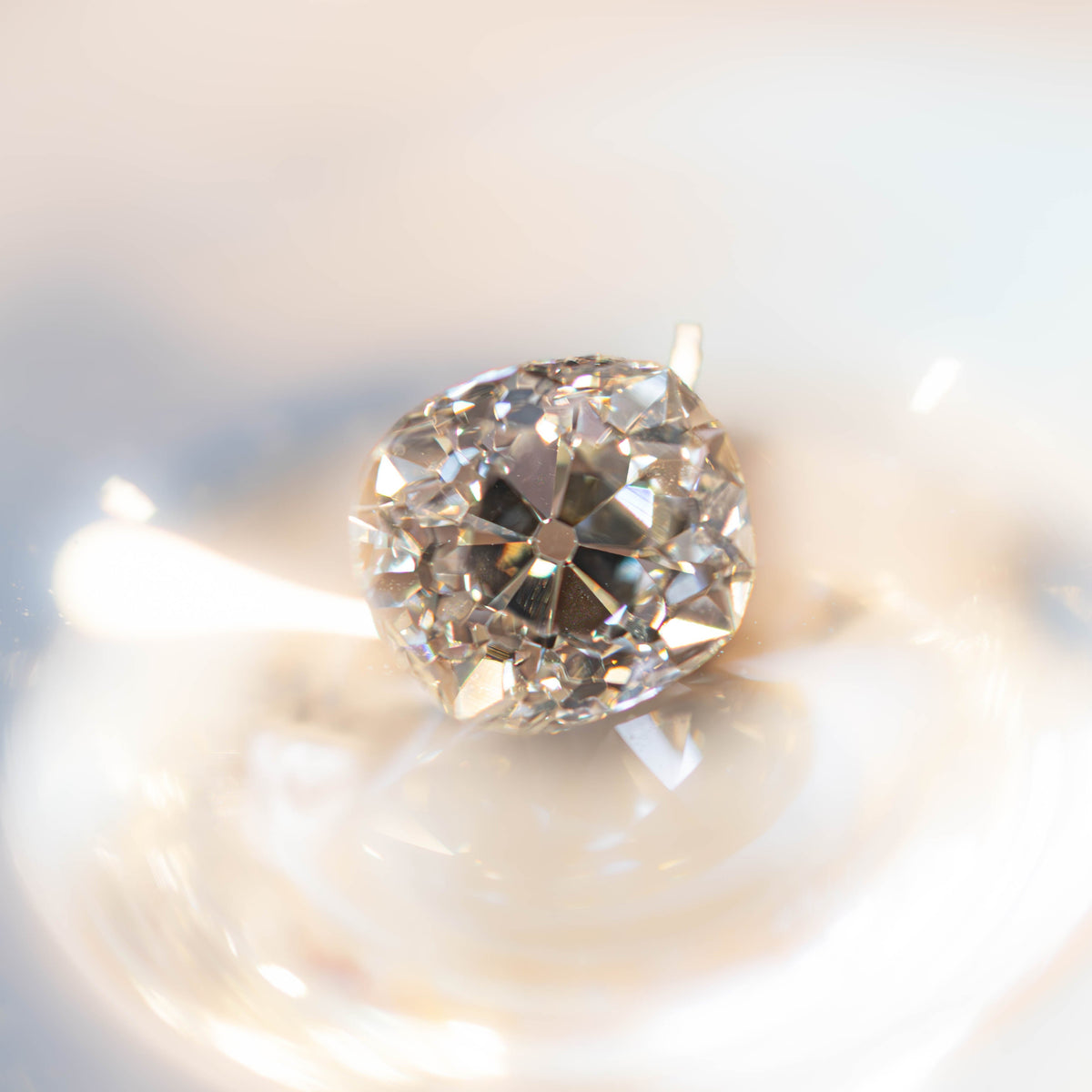
Vellum Hall uses a lot of antique diamonds, old mine cuts, old European cuts, unusual proportions, specialty cuts, warm diamonds, elongated stones and other diamonds whose appeal isn’t fully explained by the numbers on a grading report.
Two old mine cut diamonds with nearly identical specifications can look completely different.
One may have broad, slow flashes of light and a wonderfully wonky outline. Another may have a more symmetrical shape and a completely different faceting pattern. Neither is necessarily “better.” But one might be far better for a particular Vellum Hall design.
This becomes even more important with antique and antique-inspired cuts because some of the characteristics we actively like are the same characteristics a conventional diamond search system makes difficult to quantify.
We care about the shape of the stone. Its faceting. Its proportions. Its personality. How it holds light. How it relates to the architecture of the setting.
Those things are difficult to select with a slider.
We Want to See the Diamond in Hand
A grading report is important. It tells us what a diamond is.
It doesn’t always tell us what the diamond looks like.
Videos help. Supplier photographs help. Measurements help. Years of looking at diamonds certainly help.
But sometimes a stone arrives and it simply isn’t as good as we expected. Other times, a diamond that looked slightly odd on paper turns out to be fantastic.
That’s why, particularly for unusual, antique and specialty-cut diamonds, we prefer to bring stones in and evaluate them ourselves before presenting them to a client whenever possible.
We want to see how the diamond performs in normal lighting. We want to look at its color rather than simply read the letter assigned to it. We want to see whether an inclusion is actually noticeable. We want to understand the outline and faceting in three dimensions.
And most importantly, we want to know whether we actually like it.
Because if we wouldn’t choose the diamond ourselves, we don’t particularly want to sell it to you.
The Diamond Should Serve the Design
There’s another distinction here that matters to us.
We don’t think of a Vellum Hall ring as a setting with a diamond plugged into the middle of it.
The stone and the architecture have to make sense together.
A chunky old mine cut may be wonderful in one design and completely wrong in another. An elongated stone changes proportions. A shallow antique diamond may allow us to achieve a profile that a deeper modern stone won’t. Even the particular outline of a pear, oval or cushion can change the balance of the finished ring.
So when we source a diamond for a Vellum Hall piece, we’re not simply asking:
Is this a good diamond?
We’re asking:
Is this the right diamond for this piece?
Those are not always the same question.
Less, But Better
None of this means online diamond inventories are inherently bad. They can be incredibly useful, particularly for someone who already knows exactly what specifications they want and enjoys doing the research themselves.
That just isn’t the experience we’re trying to create.
Vellum Hall is built around authored jewelry. Part of that authorship is editing.
You don’t need us to give you access to 4,000 diamonds. The internet already does that extremely well.
You come to us because we have an opinion about which ones are worth looking at.
And sometimes, less really is more.