Article: You Probably Don’t Need a Perfect Diamond | Less is More Series
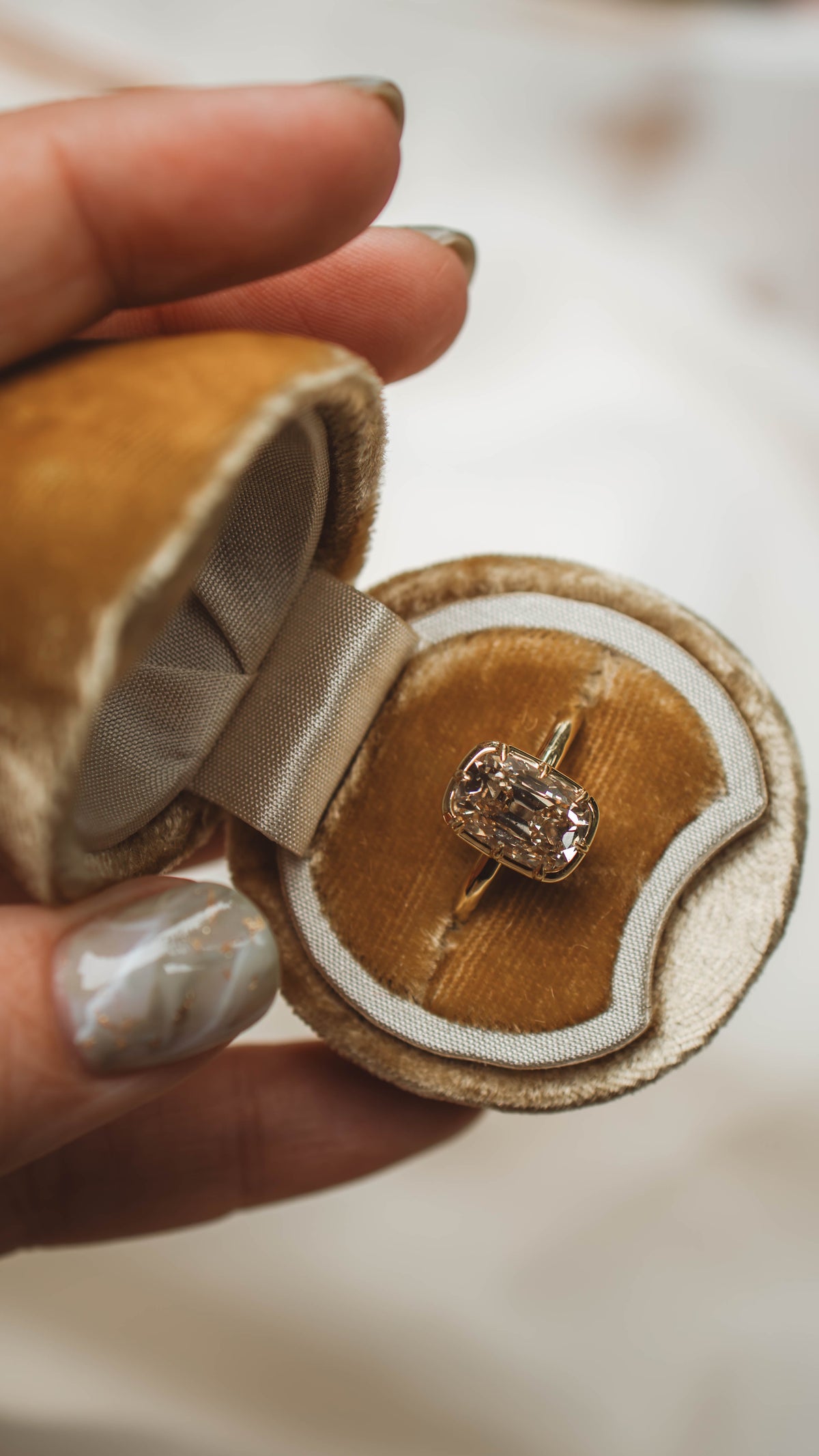
You Probably Don’t Need a Perfect Diamond | Less is More Series
You Probably Don’t Need a Perfect Diamond
If you spend enough time researching diamonds, it becomes very easy to convince yourself that you need a colorless, nearly flawless stone.
You probably don’t.
In fact, at Vellum Hall, we often prefer diamonds with lower color and clarity grades.
Not because the grades don’t matter. They do. They tell us useful information about what we’re buying.
But a diamond grading report is a description of a stone, not a verdict on whether it is beautiful.
And beautiful is ultimately what we care about.
What Diamond Color Do We Usually Recommend?
For natural diamonds, J–K color is one of our favorite places to look.
Diamond color is graded on a scale beginning with D, which represents the colorless end of the spectrum. As you move farther down the scale, diamonds begin to show increasing amounts of warmth.
That warmth is not necessarily a bad thing.
J and K color diamonds tend to occupy a particularly useful middle ground. They can still appear quite white, especially depending on the cut, setting and lighting, while having a little more softness than a truly colorless stone.
They can also represent a much better use of budget.
Instead of paying a premium to move several color grades higher, we can often put that money toward a diamond with better faceting, a more compelling shape, greater carat weight or simply more personality.
And when we’re working in yellow gold, a little warmth can be particularly lovely.
Colorless Isn’t Automatically More Beautiful
This is where personal preference matters.
A D-color diamond is rarer than a J-color diamond. That rarity affects its value.
It does not mean everyone will find it more beautiful.
Higher-color diamonds can have a very crisp, bright appearance. Lower-color diamonds can feel softer, warmer and sometimes a little more atmospheric.
We work with a lot of antique and antique-inspired diamonds, and warmth often complements those cuts beautifully. Broad facets, open culets, irregular outlines and a little color can combine to create something that feels entirely different from the precision of a modern colorless brilliant.
Neither is objectively better.
We simply tend to like diamonds with a little soul.
What Diamond Clarity Do You Actually Need?
Our approach to clarity is similarly practical:
We generally care more about whether a diamond is eye-clean than the letters printed on the certificate.
An eye-clean diamond is one where inclusions aren't readily visible to the naked eye under normal viewing conditions.
That means we don't necessarily need a VVS or VS clarity grade to consider a diamond beautiful.
A well-chosen SI diamond, for example, can sometimes offer excellent value if its inclusions are difficult to see without magnification.
But even “eye-clean” isn't an absolute rule for us.
Not Eye-Clean Doesn’t Mean Bad
Diamonds are natural materials. Inclusions are part of how they form.
And inclusions are not all created equal.
A tiny crystal near the edge of a stone is different from a dark inclusion sitting prominently beneath the table. Wispy inclusions can behave differently from feathers. Their location, size, color and effect on the diamond all matter.
So when we evaluate clarity, we don't simply ask whether a diamond has inclusions.
We ask what they are, where they are, whether they affect durability and how much we actually notice them.
Sometimes a diamond has an inclusion you can see if you know where to look, and we still think the stone is fantastic.
That isn't a flaw we're trying to hide.
It's part of the diamond.
Lower Color and Clarity Can Give a Diamond Character
There is a particular softness that can happen when you stop requiring a diamond to be technically perfect.
A little warmth changes the way the stone interacts with yellow gold. Antique faceting creates different patterns of light and shadow. An inclusion can serve as a tiny fingerprint, something specific to that particular diamond.
This is especially true with antique diamonds.
Old mine cuts and old European cuts were shaped by hand, often long before modern diamond grading standards existed. Their appeal is frequently found in the exact characteristics modern grading systems struggle to summarize: irregularity, chunky faceting, unusual proportions, warmth and individuality.
Trying to optimize every one of those characteristics out of a diamond can sometimes optimize the personality right out of it, too.
We would rather have the interesting diamond.
So Do Diamond Certificates Matter?
Absolutely.
A grading report from a respected laboratory such as GIA gives you valuable information about what you're purchasing, including the diamond's carat weight, color, clarity, measurements and other identifying characteristics.
We like certificates.
We just don't think you should shop for the certificate instead of the diamond.
A grading report allows us to understand and appropriately value a stone. It helps establish what we're buying and gives our clients an independent record of its characteristics.
What it cannot tell you is whether the faceting makes your brain light up when you turn the stone in your hand.
Unfortunately, there is no box for that.
Know What You’re Buying. Then Choose What You Like.
The 4Cs are useful because they give us a common language for evaluating diamonds.
They were never meant to make the decision for you.
For many of our natural diamond pieces, we're perfectly happy exploring J and K colors, eye-clean stones and diamonds with clarity characteristics that make sense for the particular stone.
Sometimes we'll go higher. Sometimes we'll go lower.
The goal isn't to find the highest grades available.
It's to understand what those grades mean, know what you're paying for, and then choose the diamond that is actually beautiful.
Perfect on paper and beautiful in person are two different things.
Given the choice, we'll take the latter.